> ## Documentation Index
> Fetch the complete documentation index at: https://docs.uservox.ai/llms.txt
> Use this file to discover all available pages before exploring further.
# Conditional Flow
> Route a process action to a different agent based on lead data at run time
## Overview
Conditional Flow lets you pick a different agent (Flow ID) for the same action based on what you know about a lead — without creating separate processes.
> "Use Agent A by default, but if the lead matches these rules, use Agent B instead."
The agent is chosen at the moment the action runs, using the lead's most recent data.
## Where to Find It
**Process editor → any action that has a Flow ID**
 (Make Call, Send WhatsApp, Send CD WhatsApp, Send Rampwin WhatsApp, Send Rampwin Webhook)
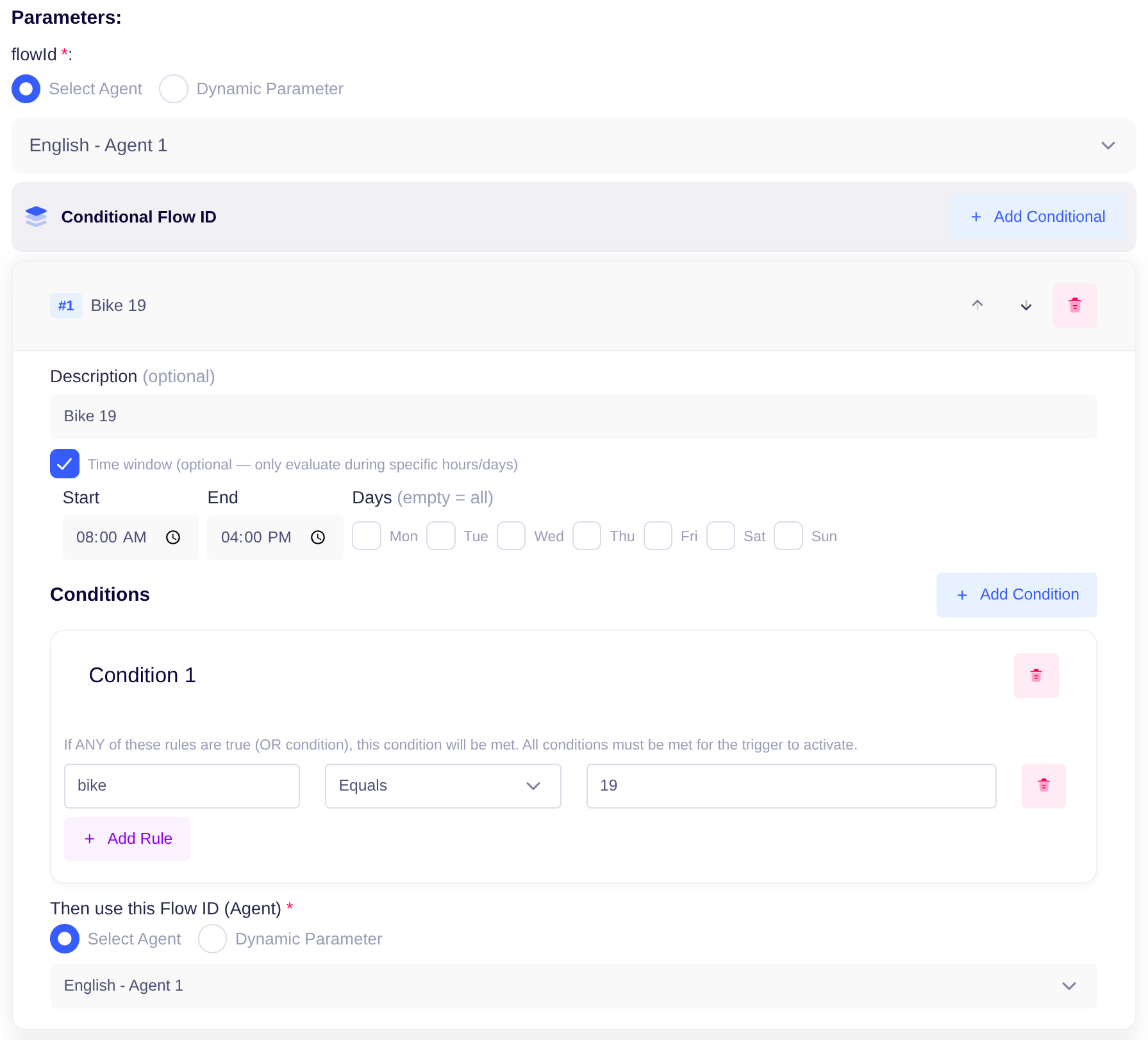
Below the existing Flow ID dropdown you will see a new section: **Conditional Flow ID** with a **+ Add Conditional** button.
## Setting Up a Rule
Each conditional card has four parts:
| Field | Purpose |
| -------------------------- | --------------------------------------------------------------------------------------- |
| **Description** (optional) | A short label for the rule |
| **Time window** (optional) | Only evaluate this rule during specific hours and/or days |
| **Conditions** | The *if* part — variable + operator + value. AND across cards, OR within the same card. |
| **Then use this Flow ID** | The *then* part — pick an agent or use a `{{variable}}` |
Use the up/down arrows to reorder rules and the trash icon to delete them.
## Time Window
Each rule can optionally be restricted to a time window. When a time window is set, the rule is **skipped entirely** if the current wall-clock time is outside the window — even if the conditions would otherwise match.
Enable it with the **Time window** checkbox on any conditional card.
| Field | Purpose |
| --------- | --------------------------------------------------------------------- |
| **Start** | Earliest time the rule is active (e.g. 09:00 AM) |
| **End** | Latest time the rule is active (e.g. 05:00 PM) |
| **Days** | Days of the week the rule applies. Leave all unchecked for every day. |
Times are interpreted in the **Asia/Kolkata** timezone.
> **Note:** Time window and conditions are evaluated together. A rule only fires when the current time is inside the window **and** the conditions match.
## How the Agent Is Picked
1. Rules are evaluated **top to bottom**.
2. The **first rule whose conditions match** is used.
3. If no rule matches, the **default Flow ID** at the top is used.
4. To add a guaranteed fallback that is not the default, add a final rule with **no conditions**.
## Things to Remember
* **Order matters** — first match wins.
* **Default still applies** when no rule matches.
* The decision is made **at run time**, even for delayed or scheduled actions.
* **Existing processes are unaffected** until you add a conditional rule.
* A rule with an **empty Flow ID** is ignored (the UI shows a red warning).
* A rule with a **time window** is skipped if the action runs outside that window — the next rule is tried instead.
## Example
| Rule | Condition | Flow ID |
| ------- | ---------------------- | --------------------- |
| 1 | `language equals hi` | Agent-B (Hindi agent) |
| 2 | `country equals India` | Agent-C (India agent) |
| Default | — | Agent-A |
A lead with `language = hi` → **Agent-B** (rule 1 matches first).\
A lead with `language = en` and `country = India` → **Agent-C** (rule 2 matches).\
All other leads → **Agent-A** (default).
## Test Cases
Use these to confirm the feature works as expected. For each case, set up the rule, push a test lead through the action, then check which Flow ID was used in the lead's call attempt or WhatsApp activity.
| # | Setup | Lead data | Expected Flow ID |
| - | -------------------------------------------------------------------------------------------------------------- | -------------------------- | ------------------------------------------------ |
| 1 | Default only — no conditional rules. Default = Agent-A. | Any lead. | Agent-A (default). |
| 2 | Single rule matches — Rule: `language equals hi` → Agent-B. Default = Agent-A. | Lead with `language = hi`. | Agent-B. |
| 3 | Single rule does not match (fallback) — same setup as #2. | Lead with `language = en`. | Agent-A (falls back to default). |
| 4 | First match wins — Rule 1: `language equals hi` → Agent-B. Rule 2: `country equals India` → Agent-C. | Lead matching both rules. | Agent-B (rule 1 is first). |
| 5 | Reordering changes outcome — same lead as #4, but move Rule 2 above Rule 1. | Lead matching both rules. | Agent-C (now rule 2 is first). |
| 6 | Catch-all — Rule 1: `language equals hi` → Agent-B. Rule 2 (last): no conditions → Agent-C. Default = Agent-A. | Lead with `language = en`. | Agent-C (catch-all rule, default never reached). |
| 7 | Empty Flow ID rule is ignored — Rule 1: `language equals hi` → (no agent picked). Default = Agent-A. | Lead with `language = hi`. | Agent-A (rule has no Flow ID, so it is skipped). |
| 9 | Undo conditional — start from #2 setup, then delete the conditional rule. | Lead with `language = hi`. | Agent-A (back to default). |
## Frequently Asked Questions
Anything on the lead — `language`, `lastDisposition`, `pastDispositions`, metadata fields, learned-data fields, etc.
The rule is ignored. The UI shows a red warning to flag it.
Delete all conditional rules. The action reverts to the default Flow ID.
That rule is skipped and the next rule is evaluated. If no remaining rules match, the default Flow ID is used.
Yes. Both must be satisfied — the current time must be inside the window and the conditions must match.
Yes. Leave conditions empty and set only a time window. The rule will then match every lead during that window.
Example — use Agent A during the day and Agent B in the evening:
| Rule | Time window | Conditions | Flow ID |
| ------- | ----------------- | ---------- | ------- |
| 1 | 9:00 AM – 5:00 PM | — | Agent A |
| 2 | 5:00 PM – 9:00 PM | — | Agent B |
| Default | — | — | Agent A |
(Make Call, Send WhatsApp, Send CD WhatsApp, Send Rampwin WhatsApp, Send Rampwin Webhook)
Below the existing Flow ID dropdown you will see a new section: **Conditional Flow ID** with a **+ Add Conditional** button.
## Setting Up a Rule
Each conditional card has four parts:
| Field | Purpose |
| -------------------------- | --------------------------------------------------------------------------------------- |
| **Description** (optional) | A short label for the rule |
| **Time window** (optional) | Only evaluate this rule during specific hours and/or days |
| **Conditions** | The *if* part — variable + operator + value. AND across cards, OR within the same card. |
| **Then use this Flow ID** | The *then* part — pick an agent or use a `{{variable}}` |
Use the up/down arrows to reorder rules and the trash icon to delete them.
## Time Window
Each rule can optionally be restricted to a time window. When a time window is set, the rule is **skipped entirely** if the current wall-clock time is outside the window — even if the conditions would otherwise match.
Enable it with the **Time window** checkbox on any conditional card.
| Field | Purpose |
| --------- | --------------------------------------------------------------------- |
| **Start** | Earliest time the rule is active (e.g. 09:00 AM) |
| **End** | Latest time the rule is active (e.g. 05:00 PM) |
| **Days** | Days of the week the rule applies. Leave all unchecked for every day. |
Times are interpreted in the **Asia/Kolkata** timezone.
> **Note:** Time window and conditions are evaluated together. A rule only fires when the current time is inside the window **and** the conditions match.
## How the Agent Is Picked
1. Rules are evaluated **top to bottom**.
2. The **first rule whose conditions match** is used.
3. If no rule matches, the **default Flow ID** at the top is used.
4. To add a guaranteed fallback that is not the default, add a final rule with **no conditions**.
## Things to Remember
* **Order matters** — first match wins.
* **Default still applies** when no rule matches.
* The decision is made **at run time**, even for delayed or scheduled actions.
* **Existing processes are unaffected** until you add a conditional rule.
* A rule with an **empty Flow ID** is ignored (the UI shows a red warning).
* A rule with a **time window** is skipped if the action runs outside that window — the next rule is tried instead.
## Example
| Rule | Condition | Flow ID |
| ------- | ---------------------- | --------------------- |
| 1 | `language equals hi` | Agent-B (Hindi agent) |
| 2 | `country equals India` | Agent-C (India agent) |
| Default | — | Agent-A |
A lead with `language = hi` → **Agent-B** (rule 1 matches first).\
A lead with `language = en` and `country = India` → **Agent-C** (rule 2 matches).\
All other leads → **Agent-A** (default).
## Test Cases
Use these to confirm the feature works as expected. For each case, set up the rule, push a test lead through the action, then check which Flow ID was used in the lead's call attempt or WhatsApp activity.
| # | Setup | Lead data | Expected Flow ID |
| - | -------------------------------------------------------------------------------------------------------------- | -------------------------- | ------------------------------------------------ |
| 1 | Default only — no conditional rules. Default = Agent-A. | Any lead. | Agent-A (default). |
| 2 | Single rule matches — Rule: `language equals hi` → Agent-B. Default = Agent-A. | Lead with `language = hi`. | Agent-B. |
| 3 | Single rule does not match (fallback) — same setup as #2. | Lead with `language = en`. | Agent-A (falls back to default). |
| 4 | First match wins — Rule 1: `language equals hi` → Agent-B. Rule 2: `country equals India` → Agent-C. | Lead matching both rules. | Agent-B (rule 1 is first). |
| 5 | Reordering changes outcome — same lead as #4, but move Rule 2 above Rule 1. | Lead matching both rules. | Agent-C (now rule 2 is first). |
| 6 | Catch-all — Rule 1: `language equals hi` → Agent-B. Rule 2 (last): no conditions → Agent-C. Default = Agent-A. | Lead with `language = en`. | Agent-C (catch-all rule, default never reached). |
| 7 | Empty Flow ID rule is ignored — Rule 1: `language equals hi` → (no agent picked). Default = Agent-A. | Lead with `language = hi`. | Agent-A (rule has no Flow ID, so it is skipped). |
| 9 | Undo conditional — start from #2 setup, then delete the conditional rule. | Lead with `language = hi`. | Agent-A (back to default). |
## Frequently Asked Questions
Anything on the lead — `language`, `lastDisposition`, `pastDispositions`, metadata fields, learned-data fields, etc.
The rule is ignored. The UI shows a red warning to flag it.
Delete all conditional rules. The action reverts to the default Flow ID.
That rule is skipped and the next rule is evaluated. If no remaining rules match, the default Flow ID is used.
Yes. Both must be satisfied — the current time must be inside the window and the conditions must match.
Yes. Leave conditions empty and set only a time window. The rule will then match every lead during that window.
Example — use Agent A during the day and Agent B in the evening:
| Rule | Time window | Conditions | Flow ID |
| ------- | ----------------- | ---------- | ------- |
| 1 | 9:00 AM – 5:00 PM | — | Agent A |
| 2 | 5:00 PM – 9:00 PM | — | Agent B |
| Default | — | — | Agent A |