> ## Documentation Index
> Fetch the complete documentation index at: https://docs.uservox.ai/llms.txt
> Use this file to discover all available pages before exploring further.
# Lead Queue Prioritization
> How different queue strategies decide which lead gets called next
## Why Queue Prioritization Matters
When many leads are waiting for calls, the system needs a clear rule for **who gets called next**.
This guide explains three queue strategies that control call order:
* **Default Attempt Priority** – Call leads in a simple waiting line.
* **Attempt Priority** – Always try brand-new leads first.
* **Last Attempted Priority** – Finish active leads quickly so they close faster.
Each strategy creates a different experience for how quickly different types of leads are contacted.
### Mixing strategies with percentages
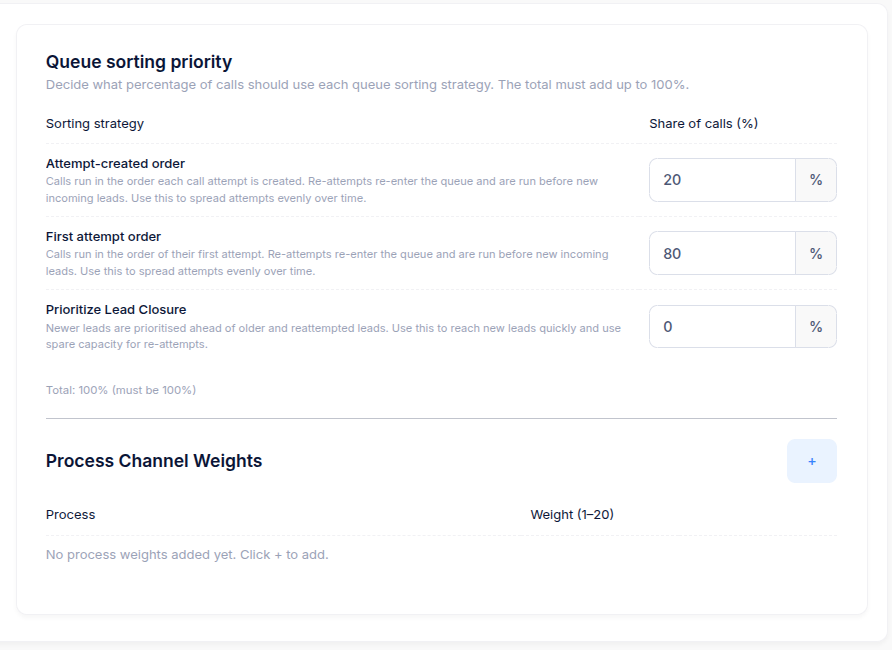
You don�t have to pick only one strategy. For each process, you can **mix and match** these three strategies by setting what **share of calls (%)** should use each one.
* The shares for the three strategies must always **add up to 100%**.
* For example, you might run **80%** of calls using the first-attempt strategy and **20%** using the default attempt order, with **0%** for lead-closure priority.
The screenshot below shows how this configuration looks in the app:
 ***
## 1. Default Attempt Priority
**Idea:** Treat the queue like a normal waiting line.
Every time a lead becomes ready for an attempt, it is placed at the **back of the queue**. Agents then call leads **from front to back**.
* Leads generally move in the order they arrive or become due.
* There is **no special preference** for first vs later attempts.
### How it feels in practice
Imagine people standing in a single line at a counter. Whoever is at the front gets served next.
* A new lead becomes ready → it joins the **end** of the line.
* When an attempt finishes and the next attempt is due, that attempt goes to the **end** as well.
### Visual
***
## 1. Default Attempt Priority
**Idea:** Treat the queue like a normal waiting line.
Every time a lead becomes ready for an attempt, it is placed at the **back of the queue**. Agents then call leads **from front to back**.
* Leads generally move in the order they arrive or become due.
* There is **no special preference** for first vs later attempts.
### How it feels in practice
Imagine people standing in a single line at a counter. Whoever is at the front gets served next.
* A new lead becomes ready → it joins the **end** of the line.
* When an attempt finishes and the next attempt is due, that attempt goes to the **end** as well.
### Visual
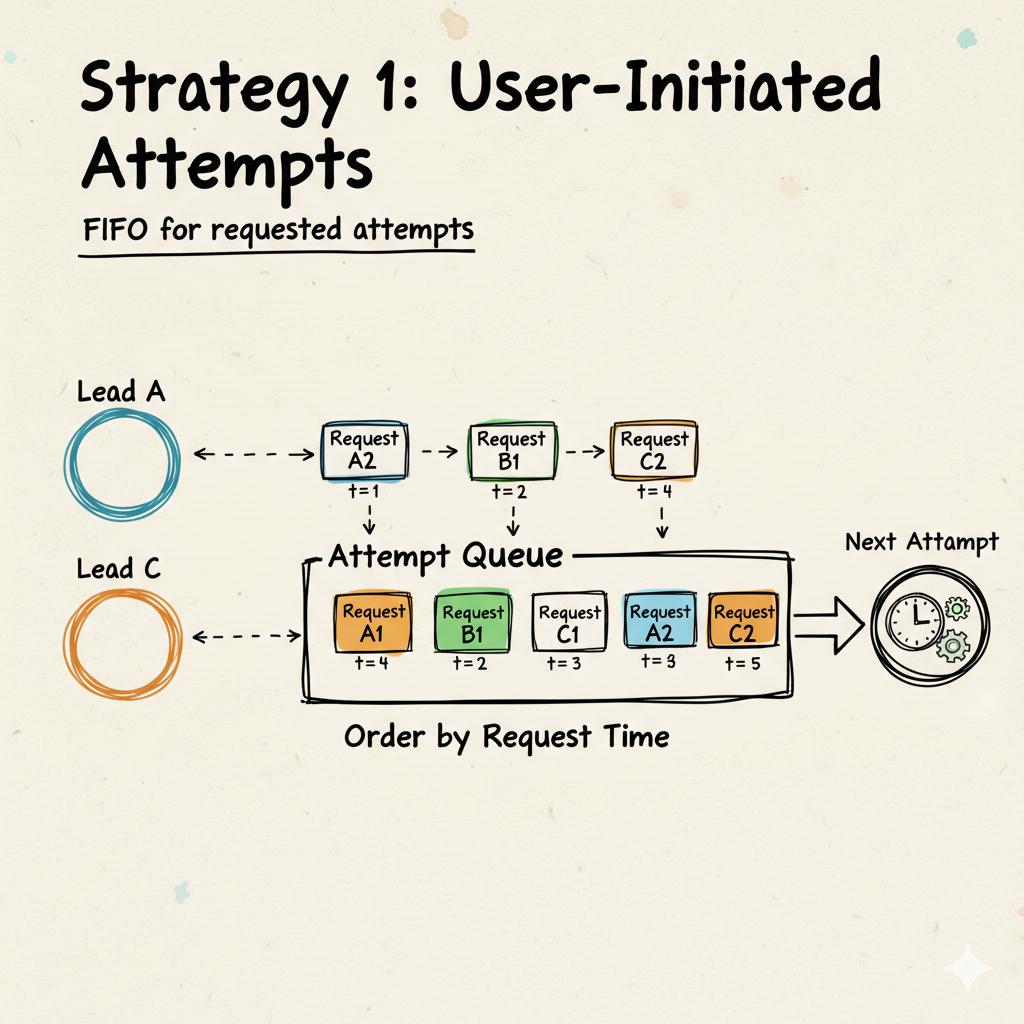 This diagram shows a simple, one-dimensional queue. Leads move forward as attempts are made.
***
## 2. Attempt Priority (First Attempts First)
**Idea:** **New leads get top priority.**
First attempts are treated as **more important** than any later attempt (2nd, 3rd, etc.).
* If a new lead enters the system, its **first attempt jumps ahead** of older leads that are waiting for follow-up attempts.
* Among all first attempts, we still respect when they arrived.
### How it feels in practice
Think of the queue as having two lanes:
* **Fast lane:** Leads on their **first attempt**.
* **Normal lane:** Leads on their **2nd, 3rd, or later attempts**.
The system always pulls from the **fast lane first**.
This means:
* Brand-new leads are called **very quickly**.
* Older leads still get follow-ups, but **only after** new first-attempt leads have been tried.
### When to use this
This strategy is useful when your top priority is to **respond to new inquiries as fast as possible**, even if some older leads wait longer between attempts.
### Visual
This diagram shows a simple, one-dimensional queue. Leads move forward as attempts are made.
***
## 2. Attempt Priority (First Attempts First)
**Idea:** **New leads get top priority.**
First attempts are treated as **more important** than any later attempt (2nd, 3rd, etc.).
* If a new lead enters the system, its **first attempt jumps ahead** of older leads that are waiting for follow-up attempts.
* Among all first attempts, we still respect when they arrived.
### How it feels in practice
Think of the queue as having two lanes:
* **Fast lane:** Leads on their **first attempt**.
* **Normal lane:** Leads on their **2nd, 3rd, or later attempts**.
The system always pulls from the **fast lane first**.
This means:
* Brand-new leads are called **very quickly**.
* Older leads still get follow-ups, but **only after** new first-attempt leads have been tried.
### When to use this
This strategy is useful when your top priority is to **respond to new inquiries as fast as possible**, even if some older leads wait longer between attempts.
### Visual
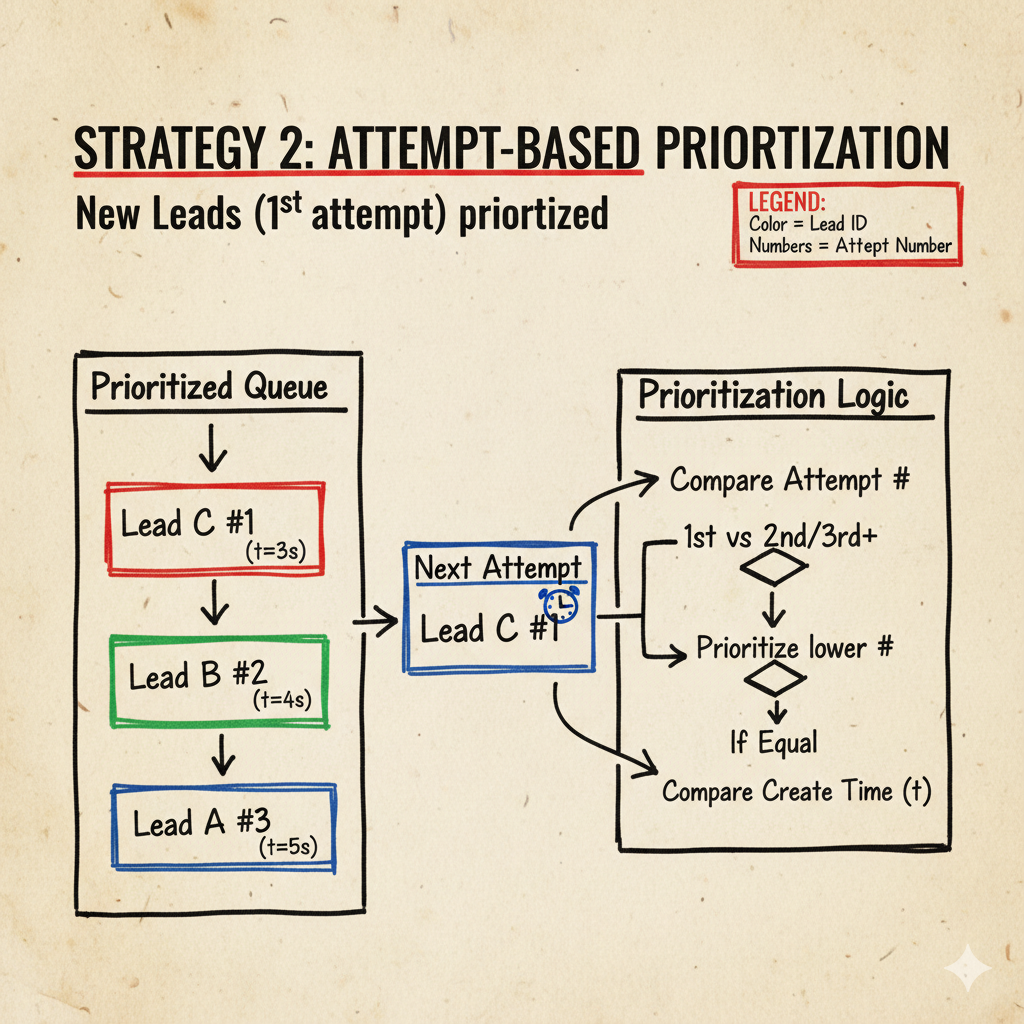 This diagram shows how new leads (first attempts) sit in a high-priority lane ahead of later attempts.
***
## 3. Last Attempted Priority (Lead Closure)
**Idea:** Once you start working on a lead, **finish it quickly**.
Leads that were **attempted recently** are given higher priority for their **next attempt**.
* If a lead was just called, its next attempt is scheduled **sooner in the queue**.
* New leads may wait a bit longer if another lead is in the middle of a fast sequence of attempts.
### How it feels in practice
Imagine each lead as a short “story” you want to finish:
* When you touch a lead (make an attempt), the system tries to **complete the story** quickly by scheduling the next attempt soon.
* This creates short bursts of activity on the same lead until it is **clearly closed** (converted, disqualified, or completed).
### Why this helps
* Reduces the number of **half-finished leads** stuck in the middle of a sequence.
* Moves more leads to a clear outcome faster.
* Useful when you care about **closure speed** and don’t mind if some brand-new leads wait slightly longer.
### Visual
This diagram shows how new leads (first attempts) sit in a high-priority lane ahead of later attempts.
***
## 3. Last Attempted Priority (Lead Closure)
**Idea:** Once you start working on a lead, **finish it quickly**.
Leads that were **attempted recently** are given higher priority for their **next attempt**.
* If a lead was just called, its next attempt is scheduled **sooner in the queue**.
* New leads may wait a bit longer if another lead is in the middle of a fast sequence of attempts.
### How it feels in practice
Imagine each lead as a short “story” you want to finish:
* When you touch a lead (make an attempt), the system tries to **complete the story** quickly by scheduling the next attempt soon.
* This creates short bursts of activity on the same lead until it is **clearly closed** (converted, disqualified, or completed).
### Why this helps
* Reduces the number of **half-finished leads** stuck in the middle of a sequence.
* Moves more leads to a clear outcome faster.
* Useful when you care about **closure speed** and don’t mind if some brand-new leads wait slightly longer.
### Visual
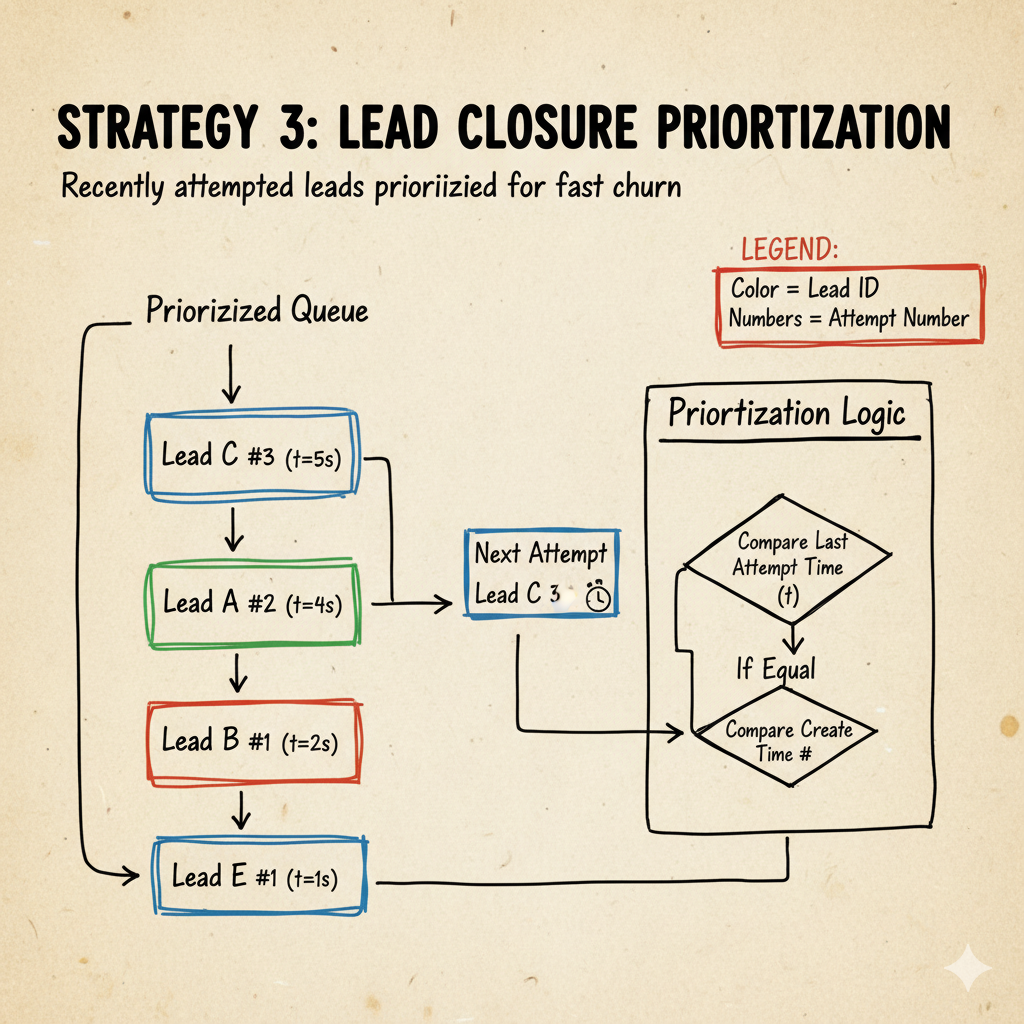 This diagram shows leads that were just attempted getting pulled forward again, so they are closed out faster.
***
## Process prioritization with channel weights
On the same screen, below the queue sorting priority, you can also **prioritize processes** using *Process Channel Weights*. This controls how your calling capacity is distributed across different processes or campaigns.
* Each row represents a process or channel.
* The **Weight (1-20)** value sets how important that process is relative to others.
* Higher weights receive a **larger share of calls** over time.
This lets you decide not just **how calls are ordered within a process** (via the three queue strategies), but also **how calls are divided across processes** based on your current business priorities.
***
## Choosing the Right Strategy
Here is a quick way to think about which strategy to use:
* **Default Attempt Priority**
* Best when you want a **simple and fair** queue.
* Everyone moves forward in roughly the order they arrive or become due.
* **Attempt Priority**
* Best when **speed-to-first-contact** is your main goal.
* New leads are always tried before follow-ups on older leads.
* **Last Attempted Priority**
* Best when you want to **close leads quickly** once you start working on them.
* Recently attempted leads are pushed forward to get a clear outcome.
You can choose the strategy that best matches your sales or outreach goals, and adjust it as your process evolves.
This diagram shows leads that were just attempted getting pulled forward again, so they are closed out faster.
***
## Process prioritization with channel weights
On the same screen, below the queue sorting priority, you can also **prioritize processes** using *Process Channel Weights*. This controls how your calling capacity is distributed across different processes or campaigns.
* Each row represents a process or channel.
* The **Weight (1-20)** value sets how important that process is relative to others.
* Higher weights receive a **larger share of calls** over time.
This lets you decide not just **how calls are ordered within a process** (via the three queue strategies), but also **how calls are divided across processes** based on your current business priorities.
***
## Choosing the Right Strategy
Here is a quick way to think about which strategy to use:
* **Default Attempt Priority**
* Best when you want a **simple and fair** queue.
* Everyone moves forward in roughly the order they arrive or become due.
* **Attempt Priority**
* Best when **speed-to-first-contact** is your main goal.
* New leads are always tried before follow-ups on older leads.
* **Last Attempted Priority**
* Best when you want to **close leads quickly** once you start working on them.
* Recently attempted leads are pushed forward to get a clear outcome.
You can choose the strategy that best matches your sales or outreach goals, and adjust it as your process evolves.